
How to Get Started Exercising
You know you should exercise as if your life depended on it. Because it does.
Research published in the Journal of Aging Research stated that:
“All-cause mortality is decreased by about 30% to 35% in physically active people as compared to inactive subjects.” (1)
The recommended standard is 150 minutes per week of moderately vigorous exercise or 75 minutes per week of vigorous exercise. There are 100 million Americans over the age of 50 who don’t get the recommended amount of exercise.
One of the most difficult things in fitness is getting started.
Between kids, commuting, work and other responsibilities of life, our modern 24/7 lifestyle leaves us feeling like there is just not enough time in the day to fit in a workout. Exercise becomes a low priority in our already crammed schedules.
Guess what! It isn’t about time. If it is important enough to you, you will find time for it.
After reviewing a wide variety of sources, from health care sites (Harvard Health, the Mayo Clinic, the Cleveland Clinic), federal agencies (CDC, the National Institute for Aging) and fitness websites I have concluded that there is no secret, just some very good advice.
If you do the following three things you have an excellent chance of starting and sustaining an exercise schedule that will get you to a healthier more active life.
- Find an activity that you like to do.
- Make it social.
- Set a goal. And then another.
Let’s take a closer look at each one.
The activity you choose can be almost anything that fits into your lifestyle and schedule. Common ones are walking, biking, swimming, running, hiking, Tai Chi Qigong, and yoga. It could also be a game like tennis, golf, basketball, and, of course, pickleball.
 Some activities are hard to do on a regular basis in all seasons. But, you don’t have to limit yourself to one activity. If you are willing to put “go to the gym/senior center” on your calendar, you can join a variety of excellent and fun classes in various forms of exercise. If you can afford it, a personal trainer can customize a workout just for you and be a great motivator too. The key is to find an activity that you get some enjoyment from doing.
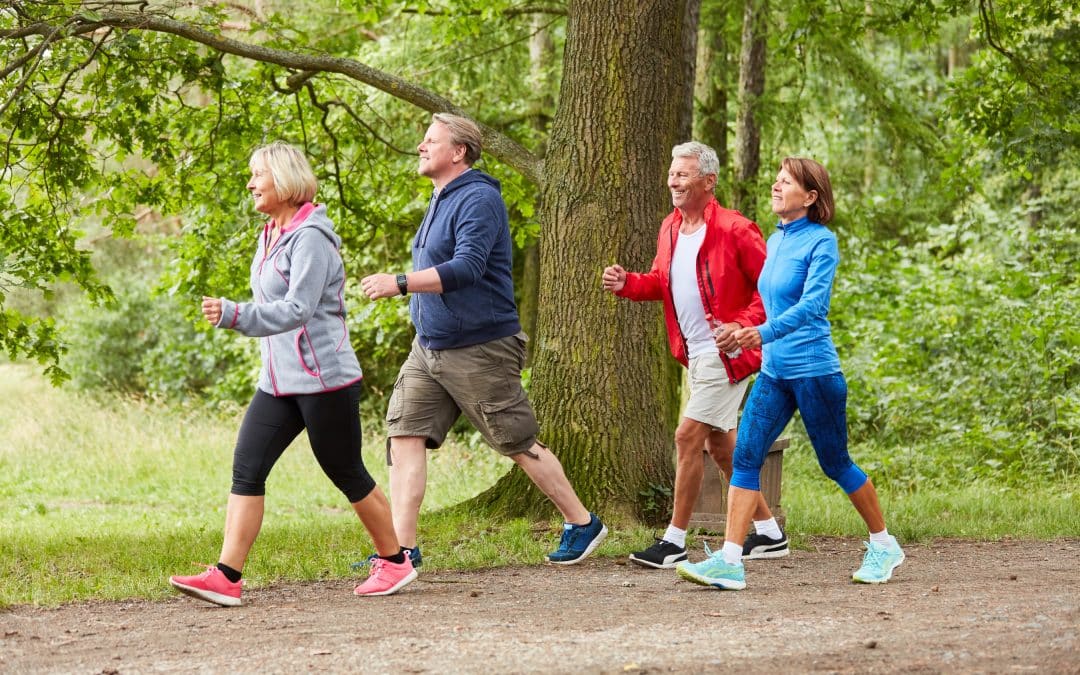
 Making it Social: You and a friend can get together for a walk, hike or jog. Group activities can also be a great way to make new friends whlie you also keep up a exercise routine. There are hundreds of walking, running and biking clubs across the country. In my neighborhood there are at least three regular walking groups. One group walks around the block a few times every day.
Setting goals is also helpful to making progress in your exercise routine. The first step is knowing where you are. For example, if you walk around the block every evening, see what it would take to walk around 2 times. How do you feel? If it seems like too much, then don’t walk all the way around the block. Simply walk to the next corner and then head back home. You are calling the shots. Do what you can do, but no more.
There is another reason to have a friend or group of friends to exercise with. You can set goals together and encourage each other to keep going. As an alternative to distance, you can encourage each other to walk a bit faster.

You can set goals even if you are not going for distance or speed. For example, in yoga you can always improve your form or the duration you can hold a position such as the tree pose.

Reaching your goal is cause for celebration. This is another reason to be in a workout group. Everyone celebrates when anyone reaches a personal goal.
Let’s Get Moving!
- Reimers, C. D. et al. Does Physical Activity Increase Life Expectancy? A Review of the Literature. J Aging Res. 2012 Jul 1; 2012:243958.