

Stretching for Enhanced Performance
Stretching has lots of benefits. It improves your range of motion and athletic performance. It reduces muscular pain and speeds recovery. There are two popular forms of stretching that help people of all ages to move more comfortably. They are static stretching and dynamic stretching.
Static stretching involves holding a stretched position for several seconds and should be performed after, or independent of, exercise to reduce delayed soreness or injury and to increase range of motion.
According to Leigh-Ann Bramble, DPT, at the Hospital for Special Surgery
“Static stretching requires you to move a muscle as far as it can go without feeling any pain, then hold that position for 20 to 45 seconds. You should repeat static stretches two to three times each. This is a very effective way to increase flexibility.” (1)
Static stretching is not advised as a warmup before exercise because it has been shown to temporarily reduce the strength of the stretched muscles. Chronic static stretching, separate from other exercise, has been shown to significantly improve flexibility. (Arntz, Chaabene)
Hamstring Stretch: Your hamstring muscle is at the back of your upper leg. The hamstrings get tight and weak from too much sitting – which, admit it, we all do (2, 3).
You can stretch your hamstring muscles by touching your toes from a standing or a seated position. Two to four slow repetitions, each held for at least 20 seconds, should be enough to improve your hamstring flexibility.

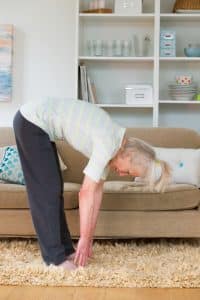
Any muscle can be stretched with the correct posture. When doing static stretching you should feel the tightness of your muscle but do not push into pain. Move slowly into the stretch position.
Dynamic stretching is a great warmup for any workout. It involves movement throughout the range of motion. Dynamic stretching improves speed, acceleration, power and agility and should be used as part of your warmup routine (4, 5).
Core Twist: The core is the central part of the body, and includes the muscles and structures that support and stabilize the spine, pelvis, and lower abdomen. The muscles of the core are engaged in most body movements including everything from a step to swinging a tennis racket to picking something up from the floor. Go for 8-12 repetitions for a warmup.
You can stretch your core by standing with your feet shoulder width apart and, keeping your hips still, hold your arms out straight and rotate your shoulders to the right and then to the left and repeat. Start by going slowly and as far as you can without pain. As you get more comfortable with this movement, you can pick up the speed a bit. But never rush it. This is a great warm up for sports like pickle ball, tennis or golf.

Arm Circles: Arm circles help your shoulders get ready for your workout or a day of activity. From a standing or a seated position, extend your arms straight out from your shoulders and move them in a circular motion. You can start with small circles and build up to larger ones until you are moving through a larger motion. Alternate between clockwise and counterclockwise motions. Continue for 10-15 seconds in each direction.

Lunge: The lunge is great for warming up the hips and legs. Start by standing with feet about shoulders width apart. Then take a big step forward with your left foot. Then lower your body so that each knee is at a 90 degree angle. It is ok to start by not going very deep. Then step your left foot back and repeat the movement with the right foot.
Go as low as you can comfortably and, as you perfect your form as you can go deeper and do more repetitions. You can put your hands on your forward knee for assistance. Ten repetitions on each side is a good goal.

Leg Swings: Another dynamic stretch for the hips is the leg swing. While standing on one leg, swing the other leg forwards and backwards. Start with small swings and work up to bigger swings. Hold onto a chair or a wall to stablize yourself if the balance component of this stretch is a challenge. A fluid, moderate pace is best.

Flexibility is one of the 4 capabilities we must maintain as we get older. Static stretching in between workouts will help expand and maintain your flexibility. Dynamic stretching is a great way to begin a workout or daily activities like gardening. Do as many repetitions as you need to warm up the muscles and joints. Stretching can be done every day.
Let’s Get Moving!
(1) Leigh-Ann Bramble. (2021). Static vs. Dynamic Stretching: What Are They and Which Should You Do? Hospital for Special Surgery, Health Library.
(2) Advantage Rehab. https://physicaltherapywyoming.com
(3) Arntz, F., et al. Chronic Effects of Static Stretching Exercises on Muscle Strength and Power in Healthy Individuals Across the Lifespan: A Systematic Review with Multi‑level Meta‑analysis. Sports Medicine (2023) 53:723–745
(4) Chaabene, H., et al. Acute Effects of Static Stretching on Muscle Strength and Power: An Attempt to Clarify Previous Caveats. Frontiers in Physiology, 19 November, 2019
(5) Phil Page. (2012) Current Concepts in Muscle Stretching for Exercise and Rehailitaion, Int J. Sports Phys Ther. 7(1):109–119.